 a) The extensive form of the game is shown to the right.
Ann has two information sets, holding a King
or holding a Queen. In both cases she has the choice to raise or fold,
thus she has the pure strategies "RR", "RF", "FR", and "FF". Beth has
only one information set with the options to call ("C") or to fold ("F"), therefore
only two pure strategies "C" and "F".
a) The extensive form of the game is shown to the right.
Ann has two information sets, holding a King
or holding a Queen. In both cases she has the choice to raise or fold,
thus she has the pure strategies "RR", "RF", "FR", and "FF". Beth has
only one information set with the options to call ("C") or to fold ("F"), therefore
only two pure strategies "C" and "F".
b) The normal form of the game looks like this:
| C | F | |
| RR | 0 | 1 |
| RF | 1/2 | 0 |
| FR | -3/2 | 0 |
| FF | -1 | -1 |
c) A Nash equilibrium in mixed strategies is Ann using "RR" with probability 1/3 and "RF" with probability 2/3, wheras Beth plays "C" with probability 2/3 and "F" with probability 1/3. The expected payoff when both players play this is 1/3 for Ann.
d) Ann raises always when receiving a king, and in 1/3 of the cases when holding a queen. Beth plays "C" with probability 2/3 and "F" with probability 1/3.
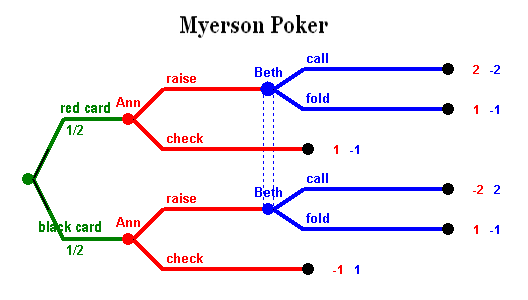 a) Let the first information set for Ann mean she has a red card
resulting with a probability of 1/2, and the second one that she has a black card,
having the same probability of 1/2. Beth has just one information set---the situation where
Ann raises and Beth doesn't know whether Ann's card is red or not.
a) Let the first information set for Ann mean she has a red card
resulting with a probability of 1/2, and the second one that she has a black card,
having the same probability of 1/2. Beth has just one information set---the situation where
Ann raises and Beth doesn't know whether Ann's card is red or not.
b) Let us just desribe how to compute one entry, "RC" versus "C", the others are done in the same way. If Ann gets a red card, she raises, and Beth calls, therefore Ann gets a payoff of 2 in this case. If Ann gets a black card, she checks, in which case her payoff is -1. Therefore her expected payoff for this pair of pure strategies is 1/2·2 + 1/2·(-1) = 1/2.
| C | F | |
| RR | 0 | 1 |
| RC | 1/2 | 0 |
| CR | -1/2 | 1 |
| CC | 0 | 0 |
c) A Nash equilibrium in mixed strategies is Ann using "RR" with probability 1/3 and "RC" with probability 2/3, wheras Beth plays "C" with probability 2/3 and "F" with probability 1/3. The expected payoff when both players play this is 1/3 for Ann.
d) Ann raises always when receiving a king, and in 1/3 of the cases when holding a queen. Beth plays "C" with probability 2/3 and "F" with probability 1/3.

a) Ann has one vertex, which forms her information set.
She has three moves, serving "KK" or "KQ" or "QQ".
Beth's decision which card to see is really not a decision (since it is based
on no information at all) but rather a random move.
Beth has two information sets, depending on whether she sees a King or a Queen.
She has three moves in each information set, guessing KK, KQ, or QQ,
therefore Beth has 32=9 pure strategies.
b) We only show Ann's payoffs, since we have a zero-sum game.
| KK,KK | KK,KQ | KK,QQ | KQ,KK | KQ,KQ | KQ,QQ | QQ,KK | QQ,KQ | QQ,QQ | |
| KK | -1 | -1 | -1 | 1 | 1 | 1 | 1 | 1 | 1 |
| KQ | 1 | 0 | 1 | 0 | -1 | 0 | 1 | 0 | 1 |
| 1 | 1 | -1 | 1 | 1 | -1 | 1 | 1 | -1 |
c) One Nash equilöibrium consists of Ann playing "KK" in 1/4 of the cases, "KQ" in 1/2 of the cases, and "QQ" in 1/4 of the cases, and Beth playing "KK,KQ", "KK,QQ", "KQ,KQ", and "KQ,QQ" each one in 1/4 of the cases. The expected payoff for both Ann and Beth is 0.
d) Since Ann has only one position, her behavior strategy is just the mixed strategy mentioned above. Beth's behavior strategy would consist in playing "KK" or "KQ" each in 1/2 of the cases when seeing a king, and "KQ" and "QQ" each in 1/2 of the cases when seeing a queen. This behavior strategy also seems to be rather natural.

| KK | KQ | QK | ||
| K | -1 | 1/7 | -1/7 | 1 |
| Q | 1 | 1/7 | -1/7 | -1 |
c) A Nash equilibrium in mixed strategies is Ann using both strategies with equal probability and Beth using just "QK". The expected outcome when both players play this is -1/7 for Ann.
d) Ann's behavior strategy is the above-mentioned mix of 50% "K" and 50% "Q". Beth selects "Q" when seeing a king, and "K" when seeing a queen.
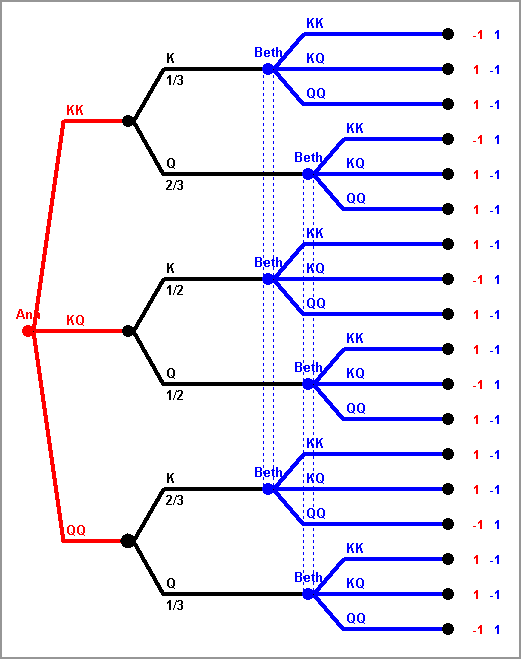
a) Ann has one vertex, which forms her information set.
She has three moves, serving "KK" or "KQ" or "QQ".
Beth's decision which card to see is really not a decision (since it is based
on no information at all) but rather a random move.
Beth has two information sets, depending on whether she sees a King or a Queen.
She has three moves in each information set, guessing KK, KQ, or QQ,
therefore Beth has 32=9 pure strategies.
b) We only show Ann's payoffs, since we have a zero-sum game.
| KK,KK | KK,KQ | KK,QQ | KQ,KK | KQ,KQ | KQ,QQ | QQ,KK | QQ,KQ | QQ,QQ | |
| KK | -1 | 1/3 | 1/3 | -1/3 | 1 | 1 | -1/3 | 1 | 1 |
| KQ | 1 | 0 | 1 | 0 | -1 | 0 | 1 | 0 | 1 |
| 1 | 1 | 1/3 | 1 | 1 | 1/3 | -1/3 | -1/3 | -1 |
c) One Nash equilöibrium consists of Ann playing "KK" in 30% of the cases, "KQ" in 40% of the cases, and "QQ" in 30% of the cases, and Beth playing "KQ,KK" in 25% of the cases, "KQ,KQ" in 15% of the cases, "QQ,KK" in 35% of the cases, and "QQ,KQ" in the remaining 25 of the cases. The expected payoff for Ann is 1/5.
d) Since Ann has only one position, her behavior strategy is just the mixed strategy mentioned above. Beth's behavior strategy would consist of playing 40% of "KQ", 60% of "QQ" when facing a king, and 60% of "KK" and 40% of "KQ" when facing a queen.
Consider the following game:

 Assume there are the following two behavior strategies
in MYERSON POKER (shown to the right) for Ann and Beth.
Ann would always raise when having a red card, and with a blue card she would raise in 1/3 of the cases.
Beth would meet in 2/3 of the cases. What are the expected payoffs for An and Beth then?
Translate this into a mixed strategies for Ann and Beth.
Assume there are the following two behavior strategies
in MYERSON POKER (shown to the right) for Ann and Beth.
Ann would always raise when having a red card, and with a blue card she would raise in 1/3 of the cases.
Beth would meet in 2/3 of the cases. What are the expected payoffs for An and Beth then?
Translate this into a mixed strategies for Ann and Beth.
The next six questions refer to the MINI LE HER(3,2) game already considered in previous exercises. This game is played with a 6 cards deck, two Aces, two Kings, two Queens. Ann and Beth get both a card at which they look without showing it to their opponent. A third card is put, back up, on the desk. Now Ann can decide whether she wants to exchange cards with Beth. Next Beth has the opportunity to exchange her card with that lying on the desk. Now both players reveal their cards, the higher one wins.
Let Ann play the behavior strategy of exchanging the card always if it is a Queen, exhanging with probability 1/3 if it is a King, and never changing an Ace. What is the corresponding mixed strategy for Ann?