 MAT200
Franklin College
Erich Prisner
MAT200
Franklin College
Erich Prisner
Every rational function can be integrated. Let's start with an example. Look at the rational function
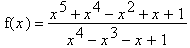
The first step would be polynomial division to write the function as a sum of a polynomial and a rational function where the degree of the numerator is less than the degree of the denominator. Since x5+x4-x2+x divided by x4-x3-x+1 equals x+2 with a remainder of 2x3+2x-2, we get

Next we factor the denominator poynomial as far as possible. We can always achieve that all factors are polynomials of degree 1 or 2. Why? Remember that every odd degree polynomial has a real zero, and therefore a linear factor. What about even degree polynomials without real zeros (linear factors?)
In our example, using the Rational Zero Theorem and again polynomial division, we can factor x4-x3-x+1 = (x2+x+1)(x-1)2. Hence



We multiply the approach equation by (x2+x+1)(x-1)2
to obtain
(Ax+B)(x-1)2+C(x2+x+1)(x-1)+D(x2+x+1)
= 2x3-x2+2x-1, or
(A+C)x3+(B-2A+D)x2+(A-2B+D)x+(B-C+D)=
2x3-x2+2x-1.
A, B, C, D are obtained by comparing coefficients---remember that
two polynomials are equal if and only if corresponding coefficients
of like terms are equal. So we solve the system of equations
A+C=2
B-2A+D=-1
A-2B+D=2
B-C+D=-1
The solution is A=2/3, B=-1/3, C=4/3, D=2/3, and we get

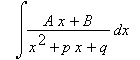 | Since (2x+p)/(x^2+px+q) can be integrated easily, this integral can be reduced to the integral of the form ... |
 | |
 | |
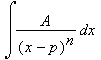 | |
| polynomials | obvious |
Erich Prisner, October 2003