 MAT200
Franklin College
Erich Prisner
MAT200
Franklin College
Erich Prisner
An agent wants to maximize (or minimize) a certain variable, which we call the target variable. He or she does this by choosing the value for some so-called choice variable. There may be more variables involved, we call these the other variables. Consider the following example:
 Two
vertical poles, AB and CD, both 2m high and standing 3m apart, are connected
by a rope, which is also anchored on the ground at point E. For which choice
of E is the length of the rope minimized? Two
vertical poles, AB and CD, both 2m high and standing 3m apart, are connected
by a rope, which is also anchored on the ground at point E. For which choice
of E is the length of the rope minimized? |
Choice variable: x target variable: f=z+w other variables: y, z, w |
We need to express the target variable in terms of the choice and other variables.
| in our example: f=z+w |
Now, since the target variable should become a function of the choice variable alone, every other variable occurring in the above equation must be expressed in terms of the choice variable and replaced. Usually we need as many equations between the variables as we have "other" (non-target and non-choice) variables. Ideally each such equation is just an equation between such an "other" variable and the choice variable, but it could be more complicated.
|
We use the Theorem of Pythagoras in the two right-angled triangels:
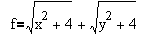
We substitute z and w by these expressions to get The only remaining non-choice variable on the right side is y. All what
remains to be done is express y also by x. We use the information that
|
The first equation is nice: just between choice variable x and other variable z. The second equation however relates the two "other" variables y and w. The third equation relates "other" variable y and choice variable x. |
Now we have a functional relation between choice and target variable. We differentiate this function with respect to choice variable, set it equal to 0, find the critical points, and so on.
|
We have the function
We diferentiate to get
The equation f'(x)=0 we solve by multiplying the equation by both radicals (to get rid of the fractions), and then we solve the resulting radical equation using College Algebra techniques. The solution is x=1.5. |
Erich Prisner, November 2004
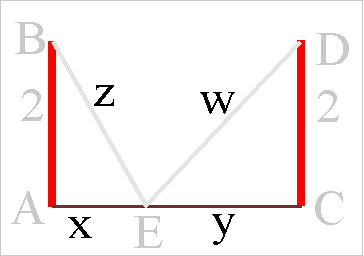 We take the same picture
and label everything we don't know yet.
We take the same picture
and label everything we don't know yet.  , which
solved for z yields
, which
solved for z yields  ,
and
,
and , which
we reformulate into
, which
we reformulate into  .
.
 and get
 . Plugging
this into the equation above yields
. Plugging
this into the equation above yields 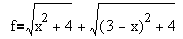 =
=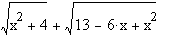

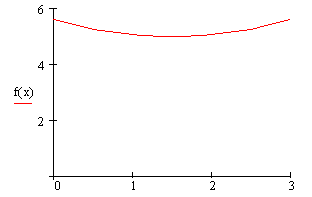 It's graph
is shown to the right, and it seems obvious that the minimum is achieved
for x=1.5.
It's graph
is shown to the right, and it seems obvious that the minimum is achieved
for x=1.5. .
.