MAT200
Franklin College
Erich Prisner
MAT200
Franklin College
Erich Prisner
An agent wants to maximize (or minimize) a certain variable, which we call the target variable. He or she does this by choosing the value for some so-called choice variable. There may be more variables involved, we call these the other variables. Consider the following example:
|
|
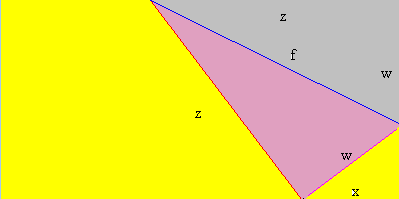
We have our target variable---the length of the blue fold, f, and three more variables, x, z, w. z and w occur twice in the picture. It is not clear which of them should be the choice variable, each one could do the job, but it will turn out that the mathematics is simplest if x is the choice variable. |
|
A piece of papers with dimensions 200*400 (pixels) as above is to be
folded. We take the upper right corner and put it somewhere on the base
line. Try this by clicking a little above the base line and the paper will
fold.
Our aim is to minimize the length of the (blue) fold. |
We need to express the target variable in terms of the choice and other variables.
We use the Theorem of Pythagoras for the grey triangle.  .
In principle we would solve this for f, but the mathematics remains easier
if we take the point of view that A=f2 is our target variable.
Obviously f is minimized whenever f2 is minimized. .
In principle we would solve this for f, but the mathematics remains easier
if we take the point of view that A=f2 is our target variable.
Obviously f is minimized whenever f2 is minimized.
|
Now, since the target variable should become a function of the choice variable alone, every other variable occurring in the above equation must be expressed in terms of the choice variable and replaced. Usually we need as many equations between the variables as we have "other" (non-target and non-choice) variables. Ideally each such equation is just an equation between such an "other" variable and the choice variable, but it could be more complicated.
The yellow triangle in the lower left corner has also a right angle. We
get  . If we remove the w2 on both sides,
we get . If we remove the w2 on both sides,
we get  . Solving this for w yields . Solving this for w yields  . .Cutting
vertically down from the left end of the blue fold creates another yellow
right-angled triangle with sides 200, z-x, and z. We get Now we substitute both z and w in the expression for the (new) target
variable A by the corresponding expressions. We get |
Now we have a functional relation between choice and target variable. We differentiate this function with respect to choice variable, set it equal to 0, find the critical points, and so on.
The drivative of A(x) is A'(x)= . The equation A'(x)=0
yields . The equation A'(x)=0
yields  , or , or  ,
or ,
or  . .
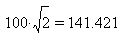
We get x2=20000, or x= |
Erich Prisner, November 2004
 ,
and simplify this to
,
and simplify this to  , and solve for z to get
 .
. ,
or
,
or 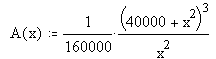 .
.